April 23, 2026
Twice a day, the forest disappears.
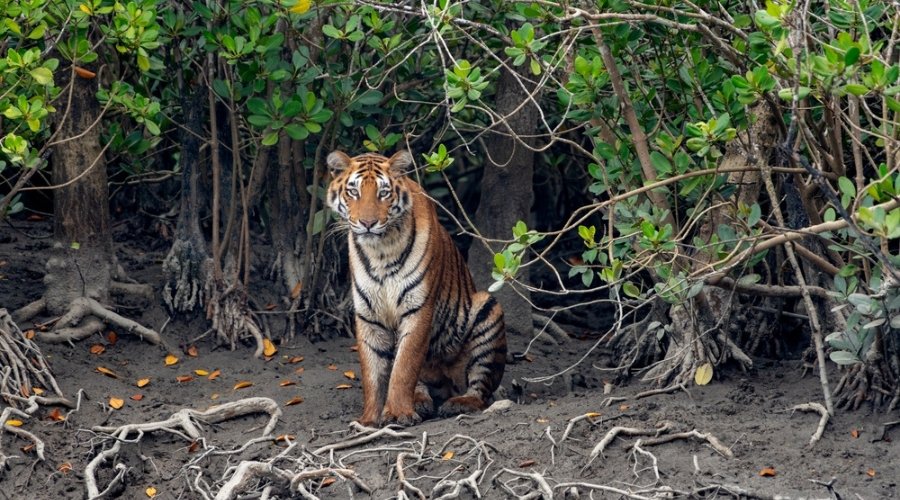
Not metaphorically. Not partially. The tidal channels of the Sundarbans rise by three to five metres and swallow kilometres of mudflat, mangrove root, and forest floor under brown, brackish water from the Bay of Bengal. The pneumatophores — the mangrove trees’ aerial breathing roots, jutting from the mud like thousands of upright fingers — vanish beneath the surface. The pathways between islands dissolve. And the animal that has claimed this shifting, saline, semi-submerged landscape as its territory — the Royal Bengal Tiger of the Sundarbans — simply waits for the tide to recede and continues.
No other tiger on Earth does what this one does. No other tiger on Earth has to.
For Australian wildlife travellers who have spent years watching Bengal tigers in the sal forests of Madhya Pradesh or the grasslands of Ranthambore, the Royal Bengal Tiger Sundarban National Park experience belongs to an entirely different category. This is not a tiger you find by reading pugmarks on a forest track. This is a tiger you encounter — if you encounter it at all — from the silent deck of a boat moving through one of the most dynamically hostile environments any large predator has ever colonised.
The Sundarbans covers approximately 10,000 square kilometres across the Bengal delta, straddling the border between India and Bangladesh where the Ganges, Brahmaputra, and Meghna river systems meet the Bay of Bengal. It is the largest continuous mangrove forest on the planet — and one of the most inhospitable environments for a terrestrial apex predator that has ever been documented.
There is almost no freshwater. The soil is waterlogged, unstable, and permeated with salt. The prey base is lean compared to the rich deer and gaur populations of central India’s forests. Dense mangrove roots make running — the standard felid pursuit strategy — largely impossible. And the entire landscape is in constant motion, reshaped by tides that operate on a six-hour cycle and have been doing so for millennia.
That a tiger not only survives here but has thrived here, raising cubs, defending territory, and maintaining a population of approximately 100 individuals on the Indian side alone, is one of the most extraordinary facts in wildlife biology.
The tide is not a background feature of the Sundarbans. It is the ecosystem’s operating system — and the tiger’s behaviour follows it with a precision that researchers have been documenting for decades.
At high tide, the lower forest floor floods completely. The tigers retreat to elevated ground — the slightly higher islands and ridges that remain above water. Prey animals concentrate on these same elevated patches. The tiger knows this. Its hunting activity peaks not at dawn or dusk, as it does in every other Indian tiger habitat, but in alignment with tidal patterns — specifically at the edges of retreating tides, when prey animals descend from elevated ground and the tiger’s ambush positions in the mangrove shadows become briefly, critically effective.
Understanding the tide is how a knowledgeable naturalist reads the Sundarbans tiger’s schedule. It is the first intelligence a RAP Safaris expedition carries into the forest.
The Sundarbans tiger is physically distinct from the Bengal tigers of India’s forests and grasslands — and the differences are the direct result of millennia of adaptation to an environment that punishes the wrong body shape.
It is smaller and stockier than inland Bengal tigers, with a leaner muscle distribution that favours swimming efficiency over raw power. Its coat is shorter and coarser — less insulative than a forest tiger’s, better suited to the constant wet-dry cycling of a tidal environment. Its coloration runs darker and more reddish-brown — a tone that dissolves into the Sundarbans’ specific palette of rust, shadow, and brackish water in ways that the orange-and-black of a forest tiger would not.
Its paws are broader, with what researchers describe as partial webbing between the digits — an adaptation that has evolved to provide both swimming efficiency and stability on the mud and pneumatophore-covered forest floor. And its kidneys process saltwater with a tolerance that no inland tiger population shares — a physiological adaptation that allows it to drink brackish water when freshwater is unavailable, which in the Sundarbans is most of the time.
The physical differences between the Sundarbans tiger and its Bengal cousins are so significant that research published in 2009 raised the possibility that this population may be diverging sufficiently to be considered a distinct subspecies. Skull morphology, body size, dietary adaptations, and behavioural patterns all showed measurable divergence from other Bengal tiger populations — divergence that scientists suggested was directly driven by the unique pressures of the tidal mangrove environment.
If that divergence continues across sufficient generations, the Sundarbans could produce something the world has not seen before: a fully aquatic big cat subspecies, shaped entirely by water, salt, and tide. The tiger that is swimming between islands in the Sundarbans right now may be in the middle of its own evolutionary story — and we are present for it.
Without open ground for pursuit, the Sundarbans tiger has become the most accomplished ambush predator in the Bengal tiger population. It hunts by stillness rather than speed — positioning itself in the mangrove shadows at tidal margins, reading the movement of spotted deer and wild boar as they navigate between elevated islands, and striking with a precision that compensates entirely for the inability to run.
According to Rakesh Arora, our field expert and RAP Safaris founder, the most extraordinary thing about the Sundarbans tiger as a photographic subject is not its appearance but its invisibility. A tiger in a sal forest leaves signs — pugmarks, alarm calls, broken vegetation. A Sundarbans tiger leaves almost nothing. The mud swallows its prints within minutes of the next tide. The mangrove absorbs its scent. It exists, in the forest’s own terminology, as pure ambush — a predator that has become so perfectly integrated into its environment that the environment itself conceals it.
The communities who enter the Sundarbans regularly have developed their own extraordinary adaptation to the tiger’s presence. The moli — traditional honey collectors who gather wild honey from the mangrove interior each spring — wear masks on the backs of their heads when working in the forest. The tiger, an ambush predator that relies on approaching prey from behind, is confused by the second face and will not attack from the rear.
This practice — developed over generations of coexistence, with no wildlife biologist’s guidance, through pure accumulated knowledge of a specific predator’s hunting pattern — is one of the most remarkable examples of human-wildlife adaptation anywhere on Earth. Before entering the forest, the moli also worship Bonobibi — the forest goddess of the Sundarbans — asking her protection from tigers in a ritual that carries no less emotional weight for being centuries old.
The Sundarbans can only be entered by water. There are no roads into the forest. No jeep tracks. No walking trails. The entire safari experience happens from the deck of a boat moving silently through tidal channels, with mangrove walls rising on both sides and the sound of the forest — kingfishers, fishing cats, the distant alarm call of a spotted deer — carrying across still water with a clarity that the forest floor never offers.
For wildlife photographers, the boat creates a photography platform of extraordinary stability and versatility. The water absorbs vibration. The height of the deck places a photographer’s eye at precisely the angle where the mangrove edge meets the waterline — exactly where a tiger emerging from the forest to drink would appear. And the silence of the approach, with no engine disturbing the animals’ natural behaviour, produces sighting conditions — when they occur — of extraordinary intimacy.
Solo travellers and female-friendly small group expeditions with RAP Safaris navigate the Sundarbans with naturalists who understand tidal timing, who know which channels have been showing recent activity, and who position the boat with the patience and precision that this particular forest demands. Tiger sightings are never guaranteed in the Sundarbans. That is part of its character. What is guaranteed is an encounter with one of the world’s most extraordinary ecosystems, read by someone who already knows how to listen to it.
Flying from Australia to the Sundarbans is well-connected through India’s aviation network. Sydney and Melbourne connect through major Asian hubs to Kolkata — the gateway city — with the Sundarbans just 100 kilometres south by road and water. The journey from Kolkata to the Godkhali jetty takes approximately three hours by road, from where boat safaris begin into the forest.
November through February is the prime window. The weather is cool and pleasant, water levels are moderate, and tiger activity near the river banks peaks as animals descend from elevated ground during tidal retreats. January offers the clearest light and the most consistent wildlife sightings. The forest is open year-round, but the pre-monsoon summer months are uncomfortably hot for extended boat time.
The Sundarbans sits naturally within a broader eastern India itinerary — the cultural heritage of Kolkata, the temple towns of Bishnupur, and the extraordinary wildlife of Kaziranga and Manas in Assam all connect into a journey that moves between India’s most ancient cities and its most extraordinary wild places.
The tide is already turning. Somewhere in the mangrove shadows, something is moving that has learned to live in a world that never stays still.
How do Royal Bengal Tigers survive saltwater in the Sundarbans?
Adapted kidneys process brackish water that would harm other tiger populations.
Can tigers really swim between islands in the Sundarbans?
Yes — Sundarbans tigers swim up to 6 km across tidal channels regularly.
What is the best time to visit Sundarbans for tiger sightings?
November to February — cool weather, moderate tides, peak bank activity.
Is the Sundarbans boat safari suitable for solo and female travellers?
Yes — RAP Safaris boat expeditions are designed safe and enriching for all travellers.
How do Australians reach Sundarban National Park?
Fly to Kolkata via Asian hubs, then three hours by road and boat to the park.