April 25, 2026
The jeep stops at the edge of Padam Talao as the morning light breaks across the water.
A crocodile slides from a mudbank without disturbing the surface. A kingfisher strikes and is gone. And then, from the crumbling stone archway of a 10th-century palace that has been standing in this forest since before European explorers reached Australia, a Bengal tiger walks into the open. Not quickly. Not nervously. It simply walks out — the way an animal walks into a space it has owned for every generation anyone can remember — and settles on the warm stone steps of the ruin like they were placed there specifically for its use.
This is Ranthambore National Park Bengal tiger safari. And the scene you just read is not exceptional. At Ranthambore, it is Tuesday morning.
The answer to the title’s question begins with terrain — and it is a more specific answer than most wildlife guides provide.
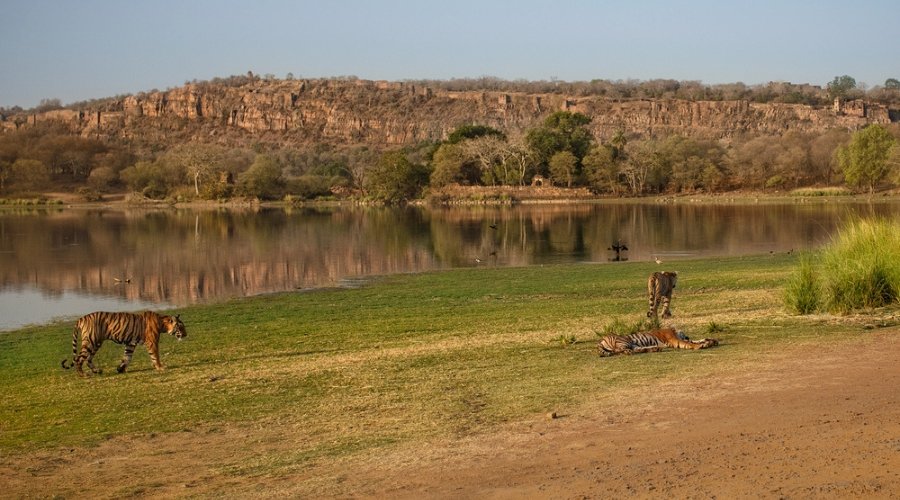
India’s most productive tiger habitats divide broadly into two types: dense forest parks where tigers are abundant but frequently invisible, and open-terrain parks where sightings are rarer but the conditions for seeing them are better. Ranthambore sits in a unique third category — a semi-arid landscape of dry deciduous forest, open grassland, rocky ridgelines, and three permanent lakes in a basin that concentrates animal activity around water in ways that dense forest never achieves.
The Aravalli and Vindhyan hills that form Ranthambore’s backdrop compress the terrain into a series of valleys and gorges that funnel tiger movement toward predictable corridors. The rocky outcrops provide elevated vantage points — from both the safari vehicle and the tiger itself. The semi-arid vegetation is open enough to provide clear sightlines from distances of fifty to three hundred metres, compared to the dense jungle parks of central India where a tiger can be fifteen metres from the track and completely invisible.
The result is a park where tigers are not simply present — they are visible. Consistently, reliably, in natural behaviour, at distances that produce images rather than glimpses.
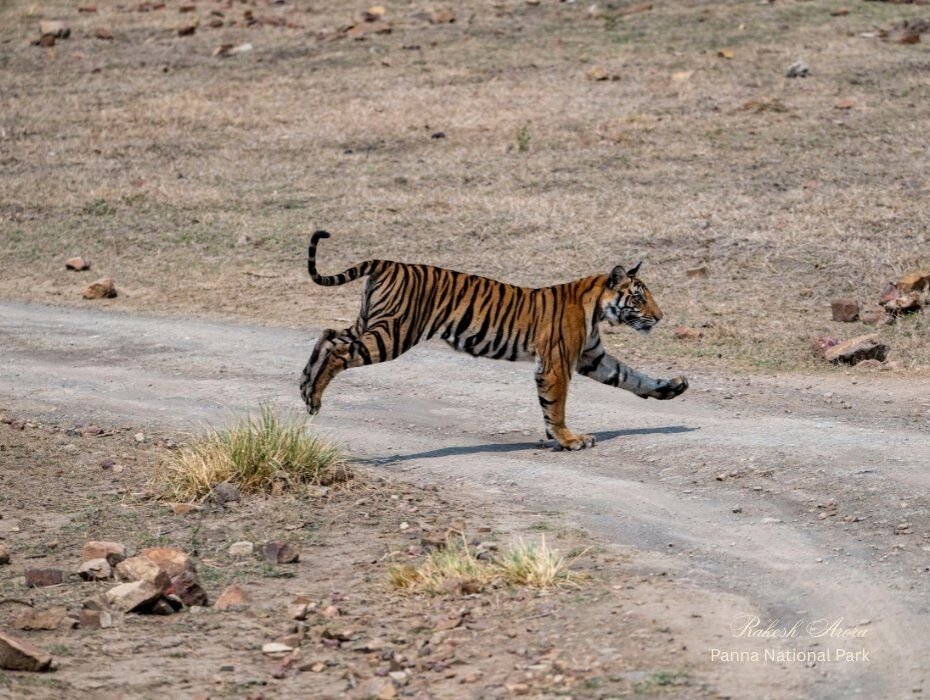
Here is the detail that most safari guides mention as a curiosity but never explain properly: Ranthambore’s tigers are diurnal. They are active during daylight hours to a degree that is unusual for Bengal tigers elsewhere in India — moving, hunting, and resting in open terrain throughout the morning and afternoon rather than confining their activity to the pre-dawn and post-dusk windows that forest tigers typically favour.
The reason is ecological and historical. Ranthambore was the exclusive hunting ground of the Maharajas of Jaipur from the 17th century through Indian independence in 1947. Two centuries of intensive hunting reduced prey density in the forest dramatically — deer and wild boar populations were suppressed by royal shoots long before the tigers came under pressure. When the forest was finally protected and prey populations began to recover, the tigers adapted their hunting schedule to follow prey activity — which in Ranthambore’s semi-arid terrain peaks during daylight hours around the three permanent lakes.
This prey-following adaptation, developed across generations of tigers, has created a population of naturally diurnal big cats. For safari travellers from Australia, this means something practically extraordinary: a morning drive that begins at first light does not need to race the clock before the tigers disappear. They are still out. Still visible. Still behaving naturally in the warming morning light, long after the forest tigers of central India have retreated to the shade.
In most Indian tiger parks, a sighting means a tiger crossing a track. It is thirty seconds of movement, often at a distance, usually in poor light, often partially obscured by vegetation. You know it happened. You may have an image. But the animal was gone before the encounter truly began.
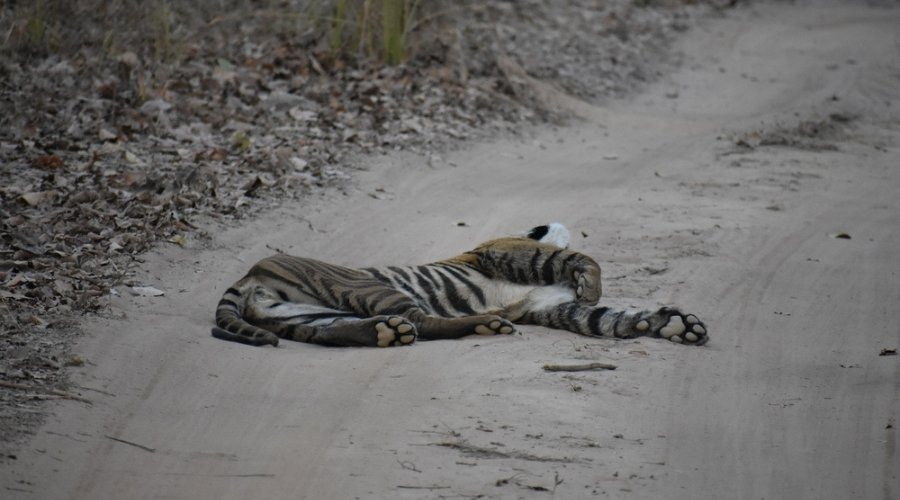
At Ranthambore, the encounter is different in character. Tigers here regularly spend extended periods in open, photographable terrain — resting on the banks of Padam Talao, moving slowly along the lake margins, using the elevated platform of ancient ruins to survey their territory. Sightings of twenty, thirty, forty minutes are not remarkable. The tiger’s comfort with vehicle presence — developed across generations in a park where safari operations have been continuous since the 1970s — means that natural behaviour continues during an encounter rather than ceasing the moment the animal becomes aware of observers.
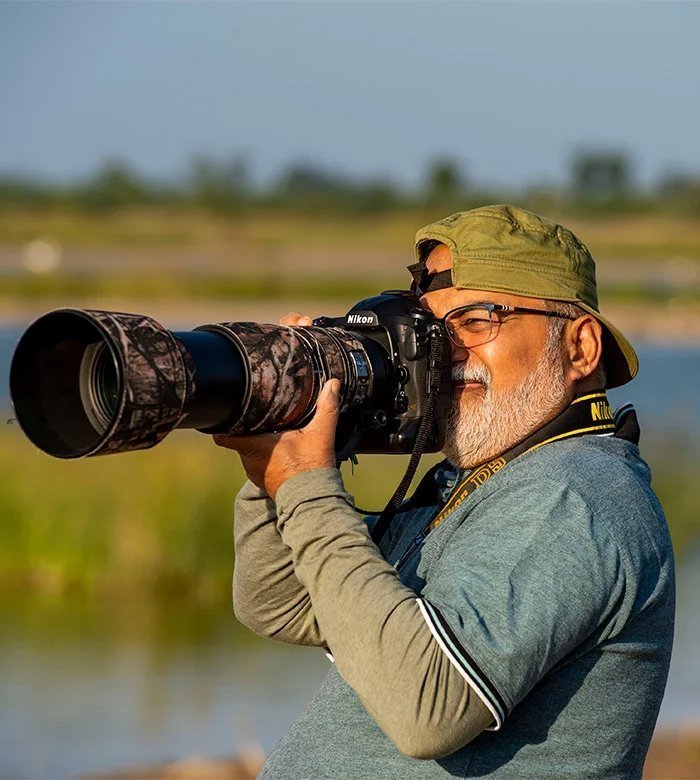
According to Rakesh Arora, our field expert and RAP Safaris founder, Ranthambore is the park where the photographic relationship between vehicle and tiger is most completely relaxed in all of India. The tigers here do not tolerate vehicles — they are genuinely indifferent to them, which is an entirely different quality. An indifferent tiger continues to live its life. A tolerating tiger waits for the vehicle to leave.
Padam Talao, Raj Bagh Talao, and Milak Talao are not simply scenic features of Ranthambore. They are the ecological mechanism that makes the park’s extraordinary sighting quality possible.
In the dry season — October through June — these three lakes become the only reliable water sources across the park’s 1,334 square kilometres. Every prey animal in the park visits them daily. Every tiger in the park follows. And the open lake margins — with their clear sightlines, their warm morning light falling across unobstructed water, and their proximity to the rocky terrain that tigers use for resting — create a photography environment of extraordinary quality.
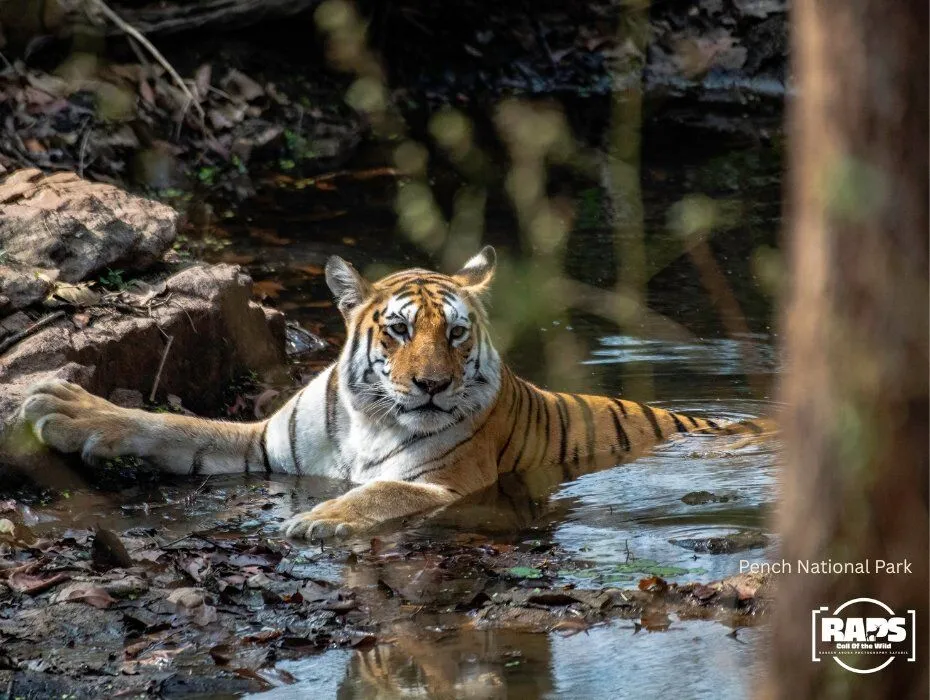
The marsh crocodile population that inhabits all three lakes adds a further dimension. Ranthambore is the only tiger reserve in India where visitors regularly witness tigers and crocodiles using the same water body simultaneously — creating inter-species tension that produces some of the most dramatic wildlife images in India’s safari canon.
The difference between a Ranthambore safari that produces two minutes of a distant tiger crossing and one that produces forty minutes with a tigress and cubs at the waterhole is not zone assignment. It is the quality of reading that happens before the vehicle reaches the lake.
Ranthambore’s open terrain makes alarm call intelligence particularly powerful here. Langur monkeys in the rocky outcrops alarm before dawn and their calls carry directional information about tiger movement across the valley. Sambar deer freeze in specific postures when a tiger is within their sight radius — and that posture can be read from a safari vehicle at 200 metres if the guide knows what to look for. Chital deer cluster and face a single direction when a predator is moving through their peripheral vision.
A naturalist who reads these signals in real time — who adjusts the vehicle’s position before the tiger emerges from cover rather than after — consistently produces encounters of a quality and duration that cannot be replicated by any amount of zone selection or permit management alone.
No tiger in India’s conservation history has been photographed more than Machali — T-16, the Queen of Ranthambore, who lived for nineteen years in the wild and produced twenty-nine cubs across her lifetime. She was responsible for generating wildlife tourism revenue estimated at over three billion rupees across her territorial life. She was the subject of a BBC documentary. She was awarded a stamp by the Indian government. And she lived her entire life around Zones 3 and 4 of Ranthambore, moving between the ruins of Raj Bagh palace and the banks of Padam Talao with a territorial confidence that made her one of the most reliably photographed animals on Earth.
Machali is gone — she died in 2016 at an age that made her one of the oldest wild tigers ever recorded. But her daughters, granddaughters, and the generations she seeded across Ranthambore’s zones carry her genetic legacy and, in many cases, her territorial confidence. Arrowhead, Krishna, and the tigresses currently holding the prime zones at Ranthambore are Machali’s inheritance. Understanding that lineage changes how a photographer approaches an encounter — not as a random wildlife event but as a chapter in a continuous story that Ranthambore has been writing for fifty years.
A RAP Safaris expedition to Ranthambore is built to ensure that the wildlife experience exists within the extraordinary cultural landscape that surrounds it — and Rajasthan, in this regard, is without equal in all of India.
The Ranthambore Fort — a UNESCO World Heritage Site standing on a rocky outcrop at the junction of two rivers within the park boundary — was built in the 10th century and has been continuously inhabited through the Chahamana Rajputs, the Delhi Sultanate, the Mughal Empire, and the Jaipur royal family. The Trinetra Ganesh Temple within the fort is one of the most venerated Ganesh shrines in Rajasthan — a place of active pilgrimage that receives thousands of visitors weekly, who walk through tiger territory to reach it in a coexistence that has never once produced a human-tiger conflict.
Sawai Madhopur, the market town at Ranthambore’s gate, offers the authentic Rajasthani kitchen in its most unadorned form. Dal baati churma — wheat balls baked over charcoal, crushed and mixed with ghee and sugar, eaten with a rich lentil dal — is one of Rajasthan’s greatest dishes and one that a morning safari makes taste like nothing else it can taste like anywhere else. Female-friendly small group tours with RAP Safaris build the fort visit, the market walk, and the evening meal naturally into each expedition day — ensuring that the Bengal tiger exists for every traveller within its full historical and cultural setting.
Flying from Australia to Ranthambore is exceptionally well-connected — and it sits within India’s most logistically convenient wildlife circuit. Sydney and Melbourne both connect through major Asian hubs to Delhi, from where Ranthambore is four hours by train — one of India’s most scenic rail journeys, running through the Rajasthan landscape at a pace that rewards anyone watching from the window.
October through April is the prime Ranthambore window. November through February offers the coolest, clearest conditions — the lake light is extraordinary in these months and tiger activity around the waterholes is consistent throughout the morning. March through May produces the most reliable sightings as water sources reduce and tigers concentrate more predictably around the remaining lakes. The park closes during monsoon from July through September.
Ranthambore sits at the heart of RAP Safaris’s Northern Tiger Trails itinerary — connecting naturally with the Taj Mahal at Agra, the bird sanctuary at Bharatpur, and the tiger forests of Kanha and Bandhavgarh in a journey that moves through the full breadth of India’s wildlife and cultural heritage in a single, deeply rewarding expedition.
The fort is already standing. The lake is already reflecting the morning sky. And somewhere between the ruins of a 10th-century palace and the warm stone of a lakeside bank, a tiger that carries fifty years of Ranthambore’s conservation story in its bloodline is deciding when to walk into the light.
Why are Ranthambore tigers active during the day?
They adapted to follow diurnal prey patterns around the park’s three lakes.
Best time to visit Ranthambore for Bengal tiger sightings?
October to April — dry season, open sightlines, tigers concentrate near lakes.
Which zones are best for tiger sightings in Ranthambore?
Zones 1 to 4 are consistently most productive for tiger encounters.
Is Ranthambore suitable for solo and female wildlife travellers?
Yes — RAP Safaris small group safaris are designed safe and enriching for all.
How do Australians reach Ranthambore National Park?
Fly to Delhi via Asian hubs, then four hours by train to Sawai Madhopur.