April 15, 2026
You have been scanning the same ridgeline for four hours.
The spotting scope is cold against your eye. The air at 4,200 metres carries a bite that the layers of merino and down have only partially answered. Around you, the Rumbak Valley of Ladakh lies in a silence so absolute that you can hear the creak of a distant glacier shifting somewhere above the snowline. Nothing moves on the slope. Nothing, as far as you can tell, is alive up there at all.
And then your guide says, very quietly: “There.”
You follow the direction of his finger to a boulder field halfway up the scree slope — grey rock, grey shadow, grey sky. And in the middle of all that grey, something is watching you back. Pale eyes. Rosettes dissolving perfectly into the stone. A tail as long as its body curled around a paw with a casual sovereignty that suggests this animal has been observing your patience test for quite some time.
Snow leopard tracking Hemis National Park is not a wildlife encounter. It is a quest. And for Australian wildlife travellers willing to undertake it, it is the one that changes everything.
Hemis National Park occupies the eastern Ladakh region of India’s Jammu and Kashmir, covering 4,400 square kilometres of the most dramatic high-altitude terrain on Earth. It is the largest national park in South Asia — and it holds the highest density of wild snow leopards of any protected area anywhere in the world.
An estimated 200 snow leopards live within Hemis alone. In all of India, between 400 and 700 individuals remain across the Himalayan and Trans-Himalayan regions — a number that makes every sighting not just a wildlife encounter but a statistically rare privilege. The park sits within the Trans-Himalayan rain shadow, which means the vegetation is sparse, the landscape open, and the sight lines across cliff faces and scree slopes extraordinary. This is one of the few places on Earth where a large, wild cat can be observed in natural behaviour across open terrain rather than glimpsed between vegetation and immediately lost.
The Rumbak Valley — the park’s most reliably productive snow leopard corridor — functions as a natural stage. South-facing slopes trap solar warmth in winter, drawing bharal herds down from the high ridges. Snow leopards follow their prey. And expert trackers, working ridgelines with spotting scopes before dawn, have developed a cumulative knowledge of individual animal territories that they carry across years in the field.
This is India’s grey ghost capital. And for wildlife travellers from Australia prepared to invest in the patience the quest demands, it delivers.
The snow leopard is, by any measure, one of the most visually extraordinary animals on the planet — and the closer you look, the more deliberately it appears to have been designed for this specific landscape.
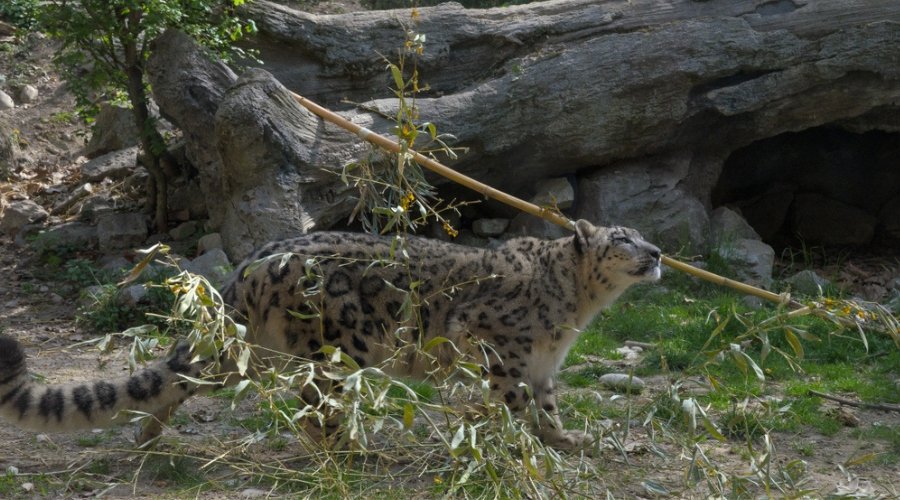
Its coat is smoke-grey, patterned with dark rosettes that break the outline of its body against rock in a way that makes the word camouflage feel inadequate. Its tail is nearly as long as its body — used for balance on steep terrain, wrapped around its face like a muffler when sleeping in the cold. Its paws are enormous relative to its body size, functioning as natural snowshoes across ice and loose scree. Its nasal passages are enlarged to warm the thin, frozen air of altitudes above 3,500 metres before it reaches the lungs. Every anatomical feature is a solution to the specific problem of living and hunting at the roof of the world.
At 4,000 metres, the light carries a crystalline quality entirely unlike anything at lower altitude. The air is thin and clean, with no atmospheric haze to soften edges or shift colour temperature. A snow leopard photographed in this light — on an exposed ridgeline at golden hour, its coat catching every last wavelength of a Ladakhi sunset — produces an image of a quality that no jungle, no forest, and no savannah can approximate. The subject, the light, and the landscape are in absolute accord.
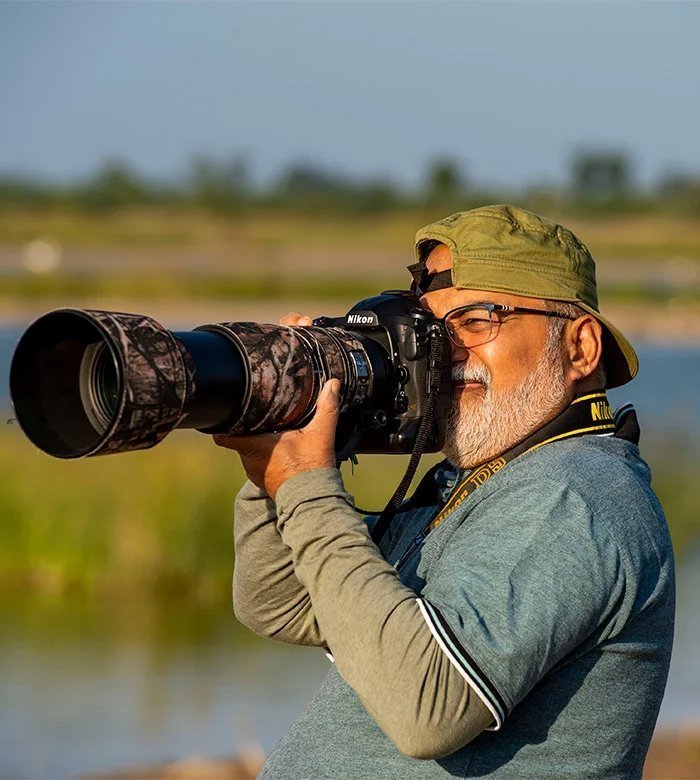
According to Rakesh Arora, our field expert and RAP Safaris founder, the snow leopard encounter demands a completely different photographic mindset from any other wildlife subject. The distances are greater, the terrain more complex, and the animal’s awareness of its surroundings more acute. Success belongs entirely to those who invest in stillness — who understand that the leopard has already noticed them and that natural behaviour continues only when it decides the presence is not a threat.
That judgment — when to move, when to stay, when to raise the camera and when to simply watch — is the skill that separates an expedition from a tourist experience.
There is a specific quality of attention that snow leopard tracking develops in people who undergo it seriously — and it is not a quality you can manufacture at lower altitude.
Each morning begins before light, with trackers already on the ridges scanning with spotting scopes while the valley is still in shadow. Reports come by radio. The team moves. Positions shift according to what the bharal herds are doing — because the bharal’s behaviour is the snow leopard’s timetable. Understanding prey movement is how an expert tracker finds a predator that has spent millennia becoming invisible.
The days of scanning teach patience as a physical practice rather than a virtue. You learn to see the landscape differently — to read rock shadows, to notice the absence of birds where there should be birds, to understand that stillness and nothing are not the same thing. Solo travellers and female-friendly small groups who commit to multiple consecutive tracking days at Hemis find that each day compounds the previous one. The valley becomes readable. The ridgeline becomes familiar. And when the leopard finally materialises from the stone — as it will — the quality of the encounter is proportional to the quality of the attention you have been developing all week.
This is what RAP Safaris expeditions are built around: not the sighting as a destination but the entire journey of becoming attentive enough to deserve it.
Hemis National Park is named for the Hemis Monastery — a 400-year-old Tibetan Buddhist gompa that sits within the park boundary itself, its whitewashed walls and golden rooftops visible from the valley floor, its prayer flags snapping in the Himalayan wind against a backdrop of rust-red cliff and eternal snow.
Ladakhi Buddhist communities have coexisted with snow leopards for centuries — and their relationship with the animal carries a reverence that is genuinely illuminating for any visitor. Local herders call the snow leopard “the glory of our mountains.” Village elders speak of its presence as an indicator of a healthy, balanced landscape. Community-based conservation programmes built on this cultural foundation have made Ladakh a global model for snow leopard protection — placing local people not as bystanders to conservation but as its primary practitioners.
The Ladakhi kitchen, austere and warming in equal measure, becomes an essential part of the experience. Thukpa — noodle broth with vegetables and dried yak meat, eaten in a homestay kitchen with the stove burning juniper wood and the temperature outside the window sitting at minus twenty — is one of those meals that cannot be separated from the landscape that produced it. Butter tea, polarising and restorative, is poured without asking by a host who understands that what a cold body needs at altitude is warmth and fat without ceremony.
RAP Safaris expeditions integrate these cultural textures naturally — ensuring that the snow leopard quest exists within its human and spiritual context rather than extracting the wildlife from the landscape that gives it meaning.
Flying from Australia to Hemis National Park requires one domestic connection after landing in India. Sydney and Melbourne both connect through major Asian hubs to Delhi, with onward domestic flights to Leh taking approximately one hour. Acclimatisation in Leh for two full days before entering the park is not optional — it is the physiological prerequisite for functioning at altitude and must be built into every itinerary.
January through March is the prime snow leopard window. As winter deepens, bharal herds descend to lower valley elevations and snow leopards follow. The combination of lower prey altitude, sparser vegetation, and open terrain produces the tracking conditions that generate Hemis’s extraordinary sighting rates. December and April offer transitional windows — less certain but less crowded — for travellers whose schedules make the peak months difficult.
The permit system for Hemis requires an Inner Line Permit, obtainable in Leh. Safari logistics — tracking teams, spotting scope positions, valley assignments — are most effectively managed by operators with established relationships with Rumbak’s local guide community. The difference between an expedition that produces a sighting and one that produces only cold hillsides is, very largely, the quality of the tracking team.
Hemis combines naturally with India’s broader northern wildlife circuit — Spiti Valley’s snow leopard territory in Himachal Pradesh, the red fox and Tibetan wolf landscapes of Changthang, and the extraordinary high-altitude wetlands of Tso Moriri — creating a northern India itinerary that goes deeper into the Himalayan wild than any other journey this subcontinent offers.
The ridgeline is waiting. The bharal are already moving. And somewhere in the grey, the ghost is watching.
Best time to track snow leopards in Hemis National Park?
January to March — bharal descend, leopards follow, sighting rates peak.
How many snow leopards live in Hemis National Park?
Approximately 200 — highest density of any protected area in the world.
Do you need to acclimatise before snow leopard tracking in Ladakh?
Yes — two full days in Leh before entering the park is essential.
Is snow leopard tracking suitable for solo and female travellers?
Yes — RAP Safaris small group expeditions are safe and deeply rewarding for all.
How do Australians reach Hemis National Park?
Fly to Leh via Delhi, acclimatise two days, then drive one hour to Hemis.