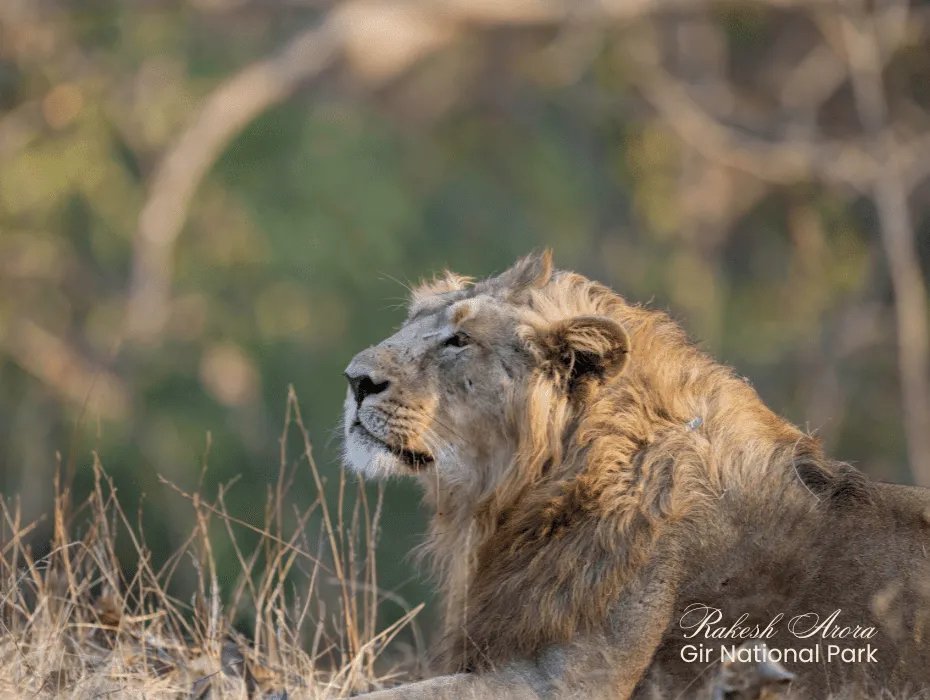
Gir National Park sits in Junagadh district, Saurashtra, in the Indian state of Gujarat, and is the last wild habitat of the Asiatic lion on Earth. The protected area covers 1,412 sq km of dry teak forest, scrub, and grassland — a landscape closer to semi-arid savanna than the lush tropical forest most visitors expect. It’s harsh, rust-and-beige country, punctuated by the occasional scarlet bloom of flame-of-the-forest trees, and it is one of India’s most consequential biodiversity strongholds — one of several national parks across India worth building an itinerary around.
Forced into this narrow forested corner of Gujarat, the Asiatic lion population has recovered dramatically since those lows. The most recent count, the Gujarat Forest Department’s 16th Asiatic Lion Census conducted in May 2025, recorded 891 lions across Gujarat — up from 674 in the 2020 census — with 384 of them within Gir National Park and its adjoining sanctuary. The remaining population has spread into surrounding districts including Amreli, Bhavnagar, and Rajkot, part of the wider Western India expedition territory we cover — a sign of how far the recovery has extended beyond Gir’s original boundaries.
When the park is open
Gir closes annually for the monsoon, typically from 16 June to 15 October, though in recent years this closure has occasionally extended into late October depending on conditions. The Gujarat Forest Department confirms exact dates each season through its official Gir booking portal — we check current status before finalising any itinerary, so get in touch and we’ll confirm live availability for your travel window.
How safaris work
Gir operates on a permit system, with a limited number of jeep safari slots released daily and bookable in advance through the official portal. The Devalia Interpretation Zone — a fenced section of the sanctuary offering near-guaranteed sightings — closes every Wednesday, separate from the main jungle safari’s own closure calendar.
Safari timings
Timings shift with the season: broadly 6:00–9:30 AM for the morning safari and 3:00–6:00 PM for the evening safari in winter, adjusting earlier and later through the hotter months. Exact gate times are confirmed on the day by our guide.
Experience India’s Wonders with Us, From Australia to Wild Stories of India.