May 5, 2026
The Little Rann of Kutch in Gujarat is the only place on Earth where you can photograph the Indian Wild Ass in its natural habitat — and Rakesh Arora has been documenting them there across more than a decade of field expeditions. What follows is a working guide to where they are, how to photograph them well, and why this single ecosystem matters more than most travellers realise.
The Little Rann of Kutch is the sole surviving wild habitat for the Indian Wild Ass (Equus hemionus khur) — a subspecies found nowhere else on the planet. The Wild Ass Sanctuary covers approximately 4,953 square kilometres, making it the largest wildlife sanctuary in India by area, and it currently supports a population of around 7,000 individuals according to the most recent Gujarat Forest Department census.
Locally known as the Khur or Ghudkhur, this animal once ranged across western India, Pakistan, and parts of the Middle East. Today, the entire global wild population is contained within this single salt desert ecosystem. The IUCN currently lists the species as Near Threatened — a status that reflects both the ongoing recovery of population numbers and the fragility of having every wild individual concentrated in one geographic location.
The Indian Wild Ass survives in the Rann through a combination of physiological endurance, social organisation, and seasonal mobility that no other large Indian mammal replicates at this scale.
The Rann itself is a punishing landscape. Summer temperatures regularly exceed 45°C, monsoon flooding transforms the salt flats into shallow inland seas, and the dry season produces a hard-baked white surface that radiates heat from below as well as above. Within this, the Khur thrives — feeding on saline-tolerant grasses, sedges, and the bets (raised grassland islands) that emerge between flood cycles.
The species can sprint up to 70 km/h across open ground and routinely covers significant daily distances in search of forage. Stallions establish territories during the breeding season, while harems of mares and foals range together year-round. For Rakesh, photographing this social structure has always required patience — the animals are wary, the light is brutal, and the landscape itself is part of the subject.
Photographing the Indian Wild Ass is technically different from any other Indian wildlife because the subject, the light, and the terrain operate together in ways no forest or grassland park replicates.
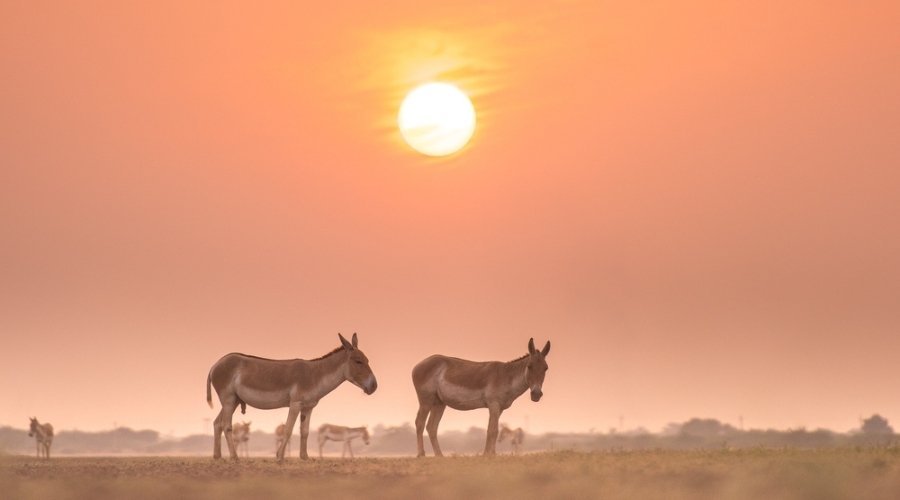
The Rann offers no cover. There are no trees to break sightlines, no understory to soften shadows, and no reference points for scale beyond the horizon itself. This produces images of extraordinary minimalism — a single galloping Khur against a white salt plain, dust trailing behind, sky bleeding into ground at the edges of the frame.
The technical challenges are real. Heat haze distorts long-lens focus during midday hours, mirages routinely fool autofocus systems, and the reflective surface of the salt produces exposure readings that fool most cameras into underexposing the subject. Panning shots of running herds require shutter speeds carefully matched to terrain — too fast and you lose the dust, too slow and the subject blurs beyond recognition.
Rakesh’s field positioning has always focused on golden-hour windows — the first 90 minutes after sunrise and the final hour before sunset, when low-angle light separates the subject from the salt and produces the saturated colour that makes Rann photography immediately recognisable.
Outside the Little Rann of Kutch, no other location in India supports a self-sustaining wild population of the Indian Wild Ass. The Greater Rann of Kutch holds occasional dispersing individuals, and the Banni grasslands to the north see seasonal movement during monsoon flooding — but neither qualifies as a primary habitat.
For travellers seeking other wild equids globally, Tibet, Mongolia, and parts of Iran support related Asiatic Wild Ass subspecies. But the khur — the specific subspecies of the Indian Rann — is genetically distinct, and seeing it in the wild is only possible at this single location. That exclusivity is part of why every RAP Safaris Safaris LRK expedition is structured around it.
The most effective way to photograph the Indian Wild Ass is through a structured Gujarat wildlife circuit that combines the Little Rann of Kutch with Velavadar Blackbuck National Park and Gir National Park — covering three of India’s most photographically distinctive ecosystems in one journey.
RAP Safaris’ Gir Velavadar LRK Tour is built around exactly this circuit, led by Rakesh personally, with field positioning, vehicle access, and accommodation timed to maximise photographic light and animal activity. October through March is the optimal window — flood waters have receded, herds are concentrated, and the harsh summer heat has not yet arrived.
For a complete view of India’s wildlife reserves, the National Parks section of the RAP Safaris website covers each destination in detail. The Western India Expeditions page outlines how the Gujarat circuit fits into a broader regional itinerary. To begin planning, the Contact page is the direct route to a custom expedition built around your photographic goals.
Where can I see the Indian Wild Ass in India?
Only in the Little Rann of Kutch, Gujarat — nowhere else.
How many Indian Wild Ass are left in the wild?
Around 7,000 individuals as per Gujarat census data.
Is the Indian Wild Ass endangered?
IUCN Near Threatened — population recovering but range limited.
When is the best time to visit the Little Rann of Kutch?
October to March for cool weather and best wildlife activity.
How fast can the Indian Wild Ass run?
Up to 70 km/h across open salt desert terrain.
Can I combine LRK with other Gujarat wildlife parks?
Yes — Velavadar and Gir National Park complete the circuit.
Nine days on the Chobe River aboard custom photographic boats — elephant herds by the hundred — finishing at Victoria Falls.
Explore the Chobe Safari