April 13, 2026
The grassland gives you no warning.
One moment it is perfectly still — flat and amber under a Gujarat dawn, the kind of silence that makes you aware of your own breathing. A herd of blackbucks grazes quietly in the distance, their spiralled horns catching the first copper light of morning. Then something shifts. A dominant male locks onto a rival. The tension in the herd changes in a way you feel before you see it.
And then the savannah explodes.
Eighty kilometres per hour across open grassland, in perfect morning light, with nothing between you and the action but clean Gujarati air. This is the Blackbuck National Park Velavadar safari — and for wildlife travellers from Australia chasing one of India’s most extraordinary action encounters, it is a destination that changes everything you thought you knew about what a wildlife safari could deliver.
Most wildlife parks in India hide their subjects. Tigers slip between sal trees. Leopards dissolve into rocky outcrops. Even elephants can vanish into dense jungle with an improbability that leaves visitors blinking in disbelief.
Velavadar does the opposite.
Spread across 34 square kilometres of open savannah in the Bhal region of Saurashtra, Gujarat, this small but extraordinary national park offers something rare in Indian wildlife photography — complete, unobstructed visibility across a flat, luminous landscape where everything that moves is visible, in full light, from the moment it begins.
Over 3,000 blackbucks roam these grasslands. That is the highest concentration of this species anywhere in India. Add to this a resident population of Indian wolves, striped hyenas, nilgai, and one of the world’s most spectacular migratory raptor roosts, and Velavadar delivers an encounter density that its modest size does nothing to suggest.
For photographers and wildlife lovers travelling from Australia, this open terrain feels immediately familiar — yet the subjects, the light, the culture, and the landscape are entirely, unmistakably Indian. Velavadar is not widely known on the Australian wildlife travel circuit. That is precisely what makes arriving here feel like a discovery.
The male blackbuck in breeding condition is one of the most visually striking animals India has to offer — and one of its most culturally significant.
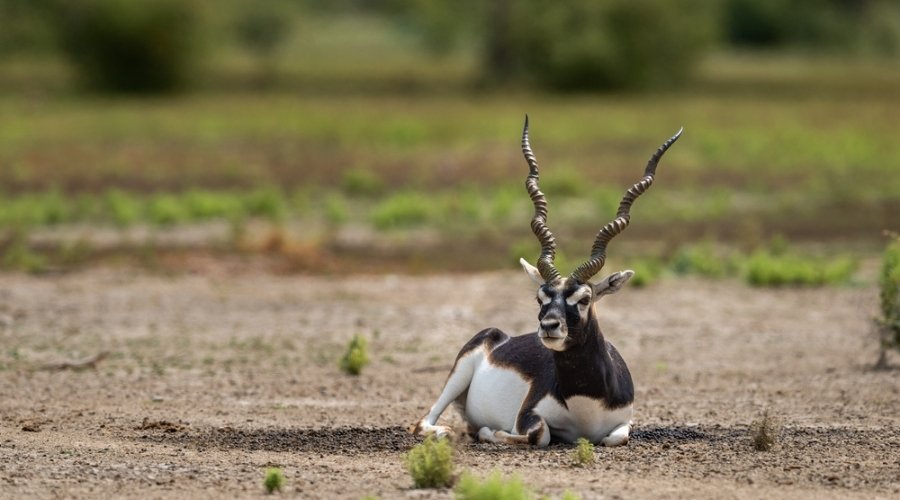
His coat is a deep, lustrous chocolate-black across his upper body, divided with extraordinary precision from a pure white underbelly, white eye-rings, and white chin. The contrast is so clean it looks applied. His horns spiral in tight corkscrews reaching up to 70 centimetres, catching light at every angle as he moves. In Sanskrit he carries the name Krishna Mrig — the antelope of Lord Krishna — considered sacred across centuries of Indian devotion, depicted in Mughal miniature paintings, carved into temple stone, and celebrated in royal hunting records that trace back over a thousand years.
He is also, when the grassland demands it, the fastest antelope in India — reaching 80 kilometres per hour in full sprint. At that velocity across open savannah, in the slanted warmth of a winter morning, the blackbuck becomes a subject that tests every skill a wildlife photographer carries. There is no cover to hide poor positioning. No forest to forgive slow reaction. Only open light, open ground, and the decision you make in the two seconds before the sprint begins.
This is why Velavadar consistently draws serious wildlife photographers back season after season. The blackbuck does not give easy images. It gives extraordinary ones — to those prepared to earn them.
The difference between a blurred background and a frame-filling blackbuck in full flight — horns sharp, dust rising, eyes focused — is not camera settings. It is the fifteen seconds before the sprint that most photographers miss entirely.
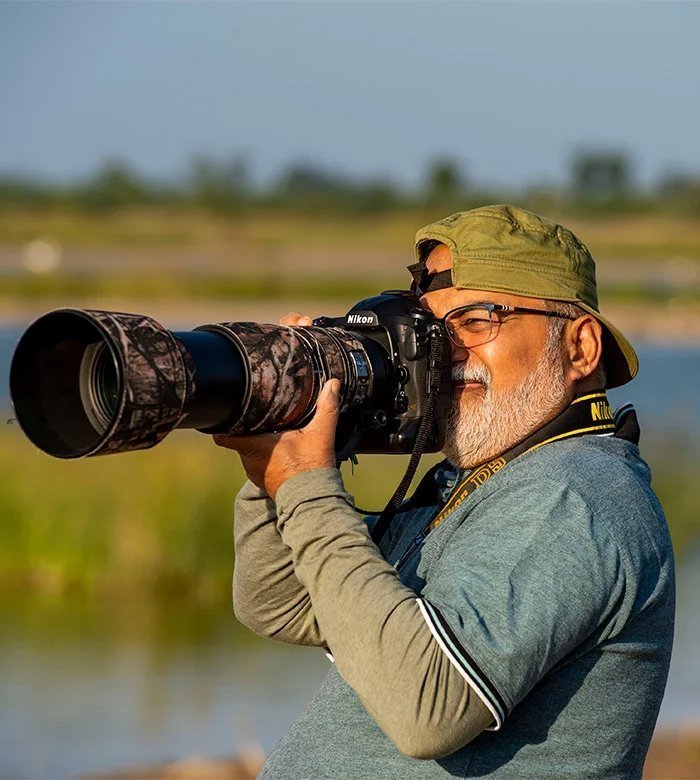
According to Rakesh Arora, our field expert and RAP Safaris founder, blackbuck behaviour broadcasts intent well before movement begins. A dominant male in a charged territorial mood carries a particular stillness — ears angled forward, gaze fixed, the muscles across his shoulders carrying a tension that reads differently from relaxed grazing posture. A subtle lowering of the head before a charge. The moment a competing male crosses an invisible territorial line and the whole herd’s attention shifts simultaneously.
These are the sentences the savannah writes before the sprint. Learning to read them is what separates anticipatory photography from reactive photography — and in open grassland, anticipation is everything.
RAP Safaris expeditions are structured around this intelligence. Each morning drive is as much a naturalist education as it is a photography session. Understanding why the blackbuck moves, where it moves, and what signals precede that movement transforms every participant — from beginner to experienced wildlife photographer — into a more attuned, more instinctive observer of animal behaviour.
That attunement, built across multiple morning drives, is precisely what solo travellers and female-friendly small group expeditions with RAP Safaris are designed to cultivate. The more mornings you spend in this grassland, the deeper the language of the savannah becomes.
The blackbuck sprint defines Velavadar’s reputation. But the park carries two more extraordinary experiences that most travel guides reduce to a single line — and both deserve far more.
The Indian wolf is one of the most endangered large carnivores on the subcontinent. Lean, long-legged, and adapted to open semi-arid grassland, it moves through Velavadar’s terrain at dawn and dusk with a low, deliberate efficiency that rewards patience and stillness. Open terrain means wolf encounters here are visible, sustained, and photographically extraordinary — the animal fully exposed against golden grass rather than glimpsed between trees. For travellers from Australia, for whom wild wolves exist only in documentary footage, standing in an open Gujarat grassland as an Indian wolf hunts at first light is an encounter that carries genuine emotional weight.
Then comes the dusk. As the sun drops toward the Gulf of Khambhat and the savannah shifts from amber to deep gold, the sky above Velavadar begins to fill with wings. Thousands of Montagu’s, Pallid, and Marsh Harriers descend simultaneously from the winter sky — a spiralling, banking convergence of raptors that continues until darkness absorbs the last of them. This is one of the largest harrier roosting concentrations in the world, and photographing it demands a completely different technical approach from the morning sprint. Backlit raptors, a sky transitioning through five shades of light in twenty minutes, thousands of moving subjects at varying distances — it is one of India’s most challenging and most rewarding wildlife photography opportunities.
A single full day at Velavadar, guided by someone who understands both subjects, opens with the blackbuck sprint and closes with the harrier roost. Very few places on Earth deliver that range within twelve hours.
Flying from Australia to Velavadar is simpler than most travellers expect.
Direct flights connect Sydney and Melbourne to Mumbai, with onward domestic connections to Ahmedabad in under two hours. From Ahmedabad, Velavadar is approximately 160 kilometres south — a comfortable three-hour drive through rural Gujarat that passes through wetlands, village markets, and bird-rich agricultural land that rewards anyone with a window and an open eye.
October through February is the prime window. Blackbuck males are in peak breeding condition, their coats at deepest colour and their territorial behaviour at full intensity. The harrier roost reaches maximum density between November and January. Indian wolves are most active in the cool pre-dawn air. And the quality of winter light across Saurashtra’s open savannah — low, horizontal, extraordinarily warm — is precisely the light that makes every frame feel considered.
The journey combines naturally with a visit to Gir National Park — the last wild refuge of the Asiatic lion — just three hours south of Velavadar. Together they create a western India itinerary that delivers three of the subcontinent’s most iconic wildlife encounters — blackbuck, lion, wolf — within a single, deeply rewarding expedition.
For travellers from Australia who want to experience India’s wild west at full depth, this combination stands apart from anything else the subcontinent offers.
The savannah is already golden. The blackbucks are already moving. All that remains is to be there when the light is exactly right.
Best time to visit Velavadar for blackbuck photography?
October to February — peak breeding season and best winter light.
How fast can a blackbuck run?
Up to 80 km/h — fastest antelope in India.
Can you see Indian wolves at Velavadar?
Yes — open terrain gives clear, sustained wolf sightings at dawn.
What is the harrier roost at Velavadar?
Thousands of raptors descend together at dusk — a world-class spectacle.
How do Australians reach Velavadar?
Fly to Ahmedabad via Mumbai, then drive 160 km south to the park.