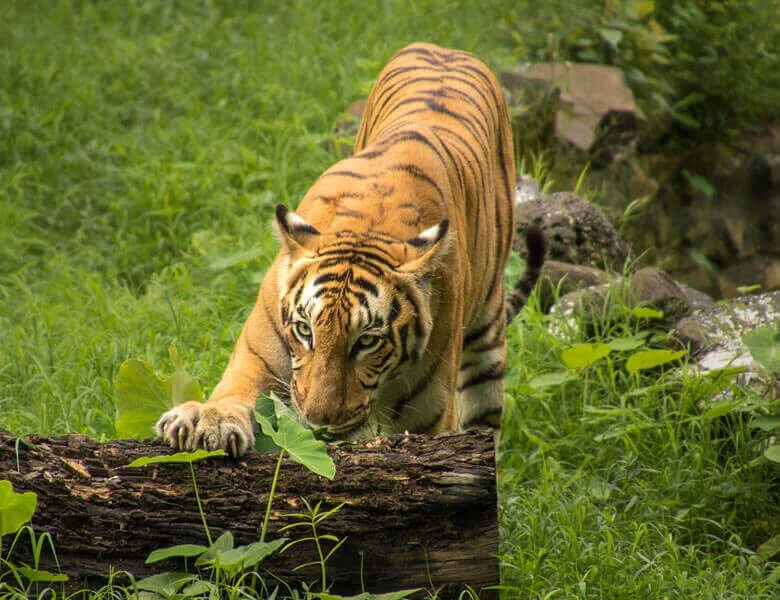
Sundarbans National Park sits in South 24 Parganas district, West Bengal, at the delta where the Ganges, Brahmaputra, and Meghna rivers meet the Bay of Bengal. It’s the world’s largest mangrove forest and the only mangrove habitat on Earth where tigers live — home to the Royal Bengal Tiger, along with saltwater crocodiles, spotted deer, and a wide range of estuarine wildlife found across India’s riverine ecosystems. Unlike India’s land-based tiger reserves, Sundarbans is explored entirely by boat, moving through tidal creeks and river channels rather than jeep tracks.
The Indian Sundarbans is home to an estimated 101 Royal Bengal Tigers, per the 2022 All-India Tiger Estimation released in 2024 by the West Bengal Forest Department — part of a slow, steady recovery tracked across successive censuses, and one of several national parks across India where this recovery is being tracked. A new census, using over 1,400 camera traps across the reserve, was underway in late 2025, with results expected to update this figure.
How permits work
Entry into Sundarban National Park and Tiger Reserve is regulated by the West Bengal Forest Department. Indian nationals can typically arrange permits same-day through the Field Director’s office at Canning or the range offices at Sonakhali, Bagna, and Sajnekhali. Foreign nationals need a special permit from the Joint Secretary, Forest Department, at Writers’ Building in Kolkata, or via the Field Director’s office — this can take 24–48 hours to process, so we build that lead time into every itinerary. There’s no single online booking portal for this reserve; permits are arranged in person, which is part of what we handle directly for guests — get in touch and we’ll take care of the paperwork ahead of your visit.
Core zone vs buffer zone
The reserve is split into a strictly protected core zone (Sundarban National Park itself) and a buffer zone that includes Sajnekhali Wildlife Sanctuary, watchtowers, and the tourist boat routes. Visitor movement is confined to designated buffer-zone channels and watchtowers — entry into the core zone outside permitted routes isn’t allowed.
Timings and access rules
Boat safaris typically run from around 7:00 AM to 4:00 PM, with no entry before sunrise or after sunset — night movement inside the reserve is prohibited. The reserve occasionally closes to all tourism, including boat cruises, for short periods during forest department census work; the most recent such closure was a two-day suspension in December 2025 during camera-trap installation for the tiger census.
Experience India’s Wonders with Us, From Australia to Wild Stories of India.