May 2, 2026
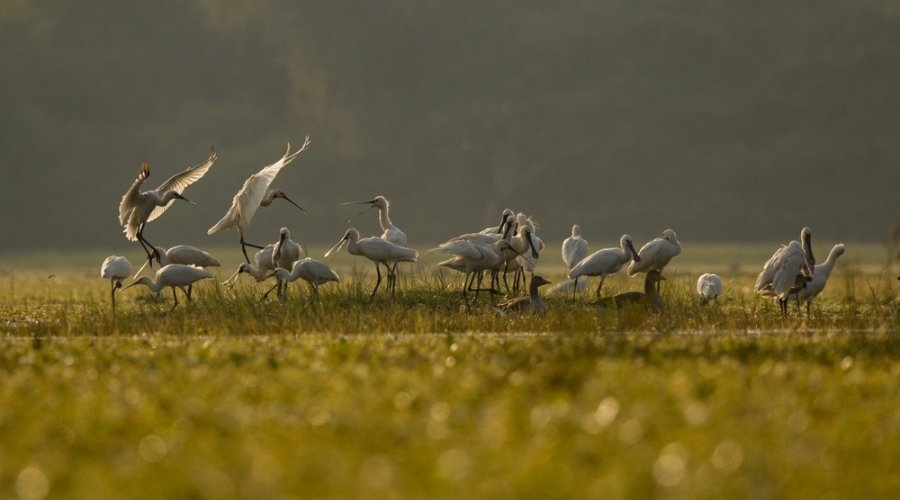
Photographers at Bharatpur Bird Sanctuary can capture migratory birds such as bar-headed geese, pelicans, painted storks, spoonbills, cranes, ducks, and several wetland species that arrive during the winter season from Central Asia and other northern regions.
There is a moment at Keoladeo Ghana National Park in the early morning of December that photographers specifically travel across continents to find.
The mist sits low over the wetland. The water is completely still. And in the first grey light before sunrise, a flock of bar-headed geese begins to descend from above the treeline — hundreds of birds, their V-formations breaking apart as they drop toward the water in a slow, banking spiral, the sound of their wings carrying across the entire sanctuary in the silence before the park’s resident birds have properly woken.
These geese crossed the Himalayas to be here. Literally. At altitudes that kill most birds. And now they are landing, thirty metres from where you are standing with your camera, on a path bordered by ancient water-edge trees, with no engine noise, no vehicle vibration, and no crowd of other photographers competing for the frame.
This is what migratory birds photographing Bharatpur Bird Sanctuary actually feels like. And it is unlike any other bird photography experience India offers.
Keoladeo Ghana National Park — named for the ancient Shiva temple dedicated to Lord Keoladeo that stands inside its boundary — covers just 29 square kilometres in the Rajasthan district of Bharatpur. In terms of area, it is tiny. In terms of bird species recorded, it is one of the richest sites on Earth: over 370 species documented, of which more than 200 are migratory — arriving from Central Asia, Siberia, China, Afghanistan, and the high plateaus of Tibet each winter to use the park’s shallow wetlands as their wintering ground.
What makes Keoladeo extraordinary for bird photographers specifically is not simply the number of species. It is the concentration. Twenty-nine square kilometres of managed wetland, woodland, grassland, and scrub, all of it functioning as a single ecological magnet for migratory birds that have been navigating toward this specific patch of water for generations. In the peak winter months, the density of birds per hectare at Keoladeo is among the highest of any protected wetland on the planet.
For Australian Photograph at Bharatpur Bird Sanctuary accustomed to working across vast distances for sparse encounters, stepping into Keoladeo in December is a genuinely disorienting experience — but in the most wonderful possible direction for Photograph at Bharatpur Bird Sanctuary.
Keoladeo does not permit motor vehicles inside the park. Visitors explore on foot, bicycle, or cycle rickshaw along the flat, shaded paths that thread between the wetland sections and woodland areas. No engines. No exhaust. No vibration transmitted through the ground that alerts birds to human approach.
The result is that Keoladeo’s birds — resident and migratory alike — have not been conditioned to associate human proximity with danger. They continue feeding, preening, displaying, and interacting at distances that in any motorised park would require a long telephoto and a lot of hope. At Keoladeo, a painted stork feeding in the shallows twenty metres from the path simply continues. A purple heron posturing at a rival continues. A flock of ruddy shelducks landing on still water between the trees continues.
According to Rakesh Arora, our field expert and RAP Safaris founder, Keoladeo is the park where the relationship between photographer and subject is most completely reversed from the standard Indian wildlife experience. In most parks, you search for the animal. At Keoladeo, the animals are simply present — and the photographer’s only task is to understand the light, read the behaviour, and be in the right position at the right moment.
The migratory species that arrive at Keoladeo each winter represent some of the most photographically extraordinary birds on Earth — and the sanctuary’s intimacy means that each of them can be photographed in ways that professional wildlife photographers specifically plan for.
The greater flamingo arrives in flocks that turn the shallow wetland sections pink in the early morning light — thousands of birds feeding in coordinated sweeps, their long necks producing reflection patterns in still water that make the wetland look designed by a graphic artist. The Eurasian spoonbill — spatula-billed, pure white, feeding in its characteristic sideways sweeping motion — is one of those birds that reads beautifully through a telephoto at thirty metres in the morning light that falls across Keoladeo’s open water areas.
The common crane — standing over a metre tall, grey-plumed, arriving in formation from Central Asia — roosts in the park’s grassland sections in flocks of dozens. In the soft pre-dawn light, a stand of cranes in ground fog, their outlines barely distinct from the mist, produces one of bird photography’s most atmospheric subjects. The ruddy shelduck, gadwall, northern pintail, and common pochard fill the wetland sections in winter concentrations that allow duck photography at close range in natural behaviour — diving, preening, displaying — with a frequency and ease that no other Indian wetland matches.
Of all the migratory birds that winter at Bharatpur, the bar-headed goose carries the most extraordinary story — and it is a story that transforms the photography from a species-ticking exercise into something with genuine emotional weight.
The bar-headed goose breeds on high-altitude lakes in Tibet and Central Asia. To reach its wintering grounds in northern India, it must cross the Himalayas — not around them, not through the passes, but directly over the highest mountain range on Earth. Recorded at altitudes above 7,000 metres, these geese have been documented flying over peaks that human mountaineers require supplemental oxygen to approach. Their haemoglobin is adapted to extract oxygen from air so thin it would render most birds unconscious. They cross at night, when temperatures are lower and air density marginally better.
When a flock of bar-headed geese descends to the wetlands of Keoladeo at dawn in December, they are completing a journey of staggering physiological achievement. Photographing them in the morning light — their white heads with twin black bars catching the horizontal sunrise, their wings folding as they settle on the still water — is knowing that these particular birds climbed higher than most Australians will ever travel in an aircraft.
In December and January, Bharatpur creates a very special environment that bird photographers carefully plan their visits around. For travellers coming from Australia for a Luxury India Safari, arriving at Keoladeo during this time can feel surprising and almost unfamiliar — but in a very positive way for bird photography. This seasonal atmosphere is unique, and no other bird sanctuary in India offers the same level of consistency and reliability for such experiences.
Morning mist at Keoladeo settles low over the wetland sections in the hours before sunrise. The park’s flat terrain and water-heavy microclimate generates a ground fog that silhouettes birds on the water’s surface against a luminous, pale background — creating the kind of photographic conditions that require no post-processing to produce emotionally powerful images. A painted stork feeding in the shallows, its reflection mirrored perfectly in still water below the fog line, with a misted treeline behind — that image makes itself. The photographer simply needs to be in the right position when the light breaks.
As the mist clears through the first hour of daylight, the quality of winter light at Keoladeo — low-angled, warm-toned, falling across open water from the south-east — creates a window of approximately ninety minutes where every water bird on the wetland is photographically perfect. The light is the reason December and January consistently produce the finest images at Keoladeo, and the reason that experienced bird photographers from Australia specifically time their visits to coincide with this window.
The migratory story at Keoladeo extends well beyond waterbirds — and the raptor dimension is the layer that most first-time visitors miss entirely.
The greater spotted eagle — globally vulnerable, with a world population estimated at fewer than 10,000 individuals — winters at Keoladeo in small but consistent numbers. Photographing a greater spotted eagle perched at the edge of the wetland in the cold morning light, its dark brown plumage carrying the pale spots of a young bird, is an encounter with one of India’s most significant raptor conservation subjects. The Pallas’s fish eagle — even rarer, with India hosting only a fraction of the global wintering population — is recorded at Keoladeo with sufficient regularity that experienced naturalists build specific search strategies around it.
Solo travellers and female-friendly small group expeditions with RAP Safaris build these raptor search strategies into the park itinerary — ensuring that every visit covers not just the spectacular waterbird spectacle but the quieter, rarer, more photographically challenging encounters that serious bird photographers return from Keoladeo specifically proud of.
Bharatpur sits in the heart of Rajasthan’s Brij cultural region — and the heritage that surrounds the bird sanctuary is as rich as the park itself.
The Bharatpur Fort — built by Maharaja Suraj Mal in the 18th century, the same ruler who created the hunting reserve that became Keoladeo — is one of Rajasthan’s most formidable military structures, its walls having repelled multiple British sieges in the colonial period. Walking through the fort’s sandstone corridors after a morning of bird photography provides a historical context that connects Keoladeo’s origins — as a Maharaja’s duck-shooting preserve — to the broader story of a region where water, power, and wildlife have been intertwined for centuries.
The Brij cuisine of the Bharatpur region is distinctive and satisfying. Bedai — a deep-fried bread served with a spiced potato curry and a sweet halwa — is the traditional Bharatpur breakfast, available at dhaba-style restaurants around the park gate in the early morning. Eaten after a two-hour dawn photography session, with the mist still visible on the wetland beyond the trees and the sound of cranes carrying from the park interior, it is the kind of meal that earns its place in the day’s memory alongside the images.
Flying from Australia to Bharatpur Bird Sanctuary is exceptionally well-connected — it sits within India’s most logistically convenient wildlife and cultural circuit. Sydney and Melbourne both connect through major Asian hubs to Delhi, from where Bharatpur is just 180 kilometres — a comfortable three-hour drive or a two-hour train journey on routes that run several times daily.
Bharatpur sits between Agra and Jaipur on the Golden Triangle circuit, making it the most naturally integrated wildlife destination in northern India for travellers who want to combine Keoladeo’s extraordinary bird photography with the Taj Mahal, Ranthambore’s Bengal tigers, and the architectural grandeur of Jaipur’s pink city.
December through February is the prime photography window. December and January offer the peak migratory species concentration, the finest morning mist conditions, and the most consistent winter light quality. February sees some migratory species beginning to depart but offers the Sarus Crane’s breeding season — the resident population engaging in courtship displays that are among the most photographically compelling behaviours in India’s bird life.
The mist is already forming over the wetland. The bar-headed geese are already beginning their descent from a sky that has no idea how extraordinary the journey behind them was. The only question is whether your camera is ready — and whether you are positioned, in the right light, in the right silence, at the right moment.
Best time to photograph migratory birds at Bharatpur?
December and January — peak species concentration, finest mist and light.
Do bar-headed geese really cross the Himalayas to reach Bharatpur?
Yes — they cross at over 7,000 metres, one of nature’s greatest migrations.
What rare raptors can be photographed at Keoladeo in winter?
Greater spotted eagle and Pallas’s fish eagle winter here in small numbers.
Is Bharatpur Bird Sanctuary suitable for solo and female travellers?
Yes — vehicle-free park and RAP Safaris small groups make it safe and enriching.
How do Australians reach Bharatpur Bird Sanctuary?
Fly to Delhi via Asian hubs, then three hours by road or two by train.
Nine days on the Chobe River aboard custom photographic boats — elephant herds by the hundred — finishing at Victoria Falls.
Explore the Chobe Safari