March 17, 2026
The elephant matriarch emerges from elephant grass standing twelve feet tall—vegetation so named because only pachyderms can navigate its towering stalks. Behind her, fifteen family members materialize in single file, trunks testing morning air while distant Brahmaputra currents whisper through reeds. Your wide-angle lens captures the entire procession: foreground grass creating depth, middle-ground elephants establishing scale, background grasslands extending toward the mighty Brahmaputra River, and beyond that, on exceptionally clear mornings, the snow-capped summit of Kangchenjunga—the world’s third-highest peak—floating 200 kilometres distant like a mirage.
This is Kaziranga National Park at its most spectacular—where wide-angle landscape photography transcends typical wildlife documentation, where one-horned rhinoceros graze meadows reclaimed from extinction’s brink, and where Australian photographers discover that India’s most compelling images require stepping back, opening frames, and capturing ecosystems rather than merely animals.
The grey giants and armoured unicorns of the Brahmaputra floodplains aren’t just subjects. They’re sculptural elements moving through compositions nature designed for cinematic grandeur.
Understanding Kaziranga’s extraordinary landscape photography opportunities requires recognising how geography shaped visual possibilities. The park sprawls across 430 square kilometres of Brahmaputra River floodplain—wet alluvial grasslands interspersed with shallow pools, deciduous woodlands, and reed marshes. During monsoon season, 70 to 80 percent of the park submerges under floodwaters forcing wildlife toward elevated Karbi Anglong hills bordering the southern edge. Come November when waters recede, an ecosystem regenerates through grass sprouting, prey species multiplying, and apex predators reclaiming territories.
For wide-angle photography, these grasslands function as natural studios. Unlike Central India’s dense forests demanding telephoto compression, Kaziranga rewards photographers willing to work 16mm to 35mm focal lengths. The compositions practically assemble themselves: vast meadows called beels providing negative space, wildlife positioned mid-frame for scale, distant tree lines creating horizontal anchors, and atmospheric moisture from the Brahmaputra generating that soft ethereal quality making images feel painted rather than photographed.
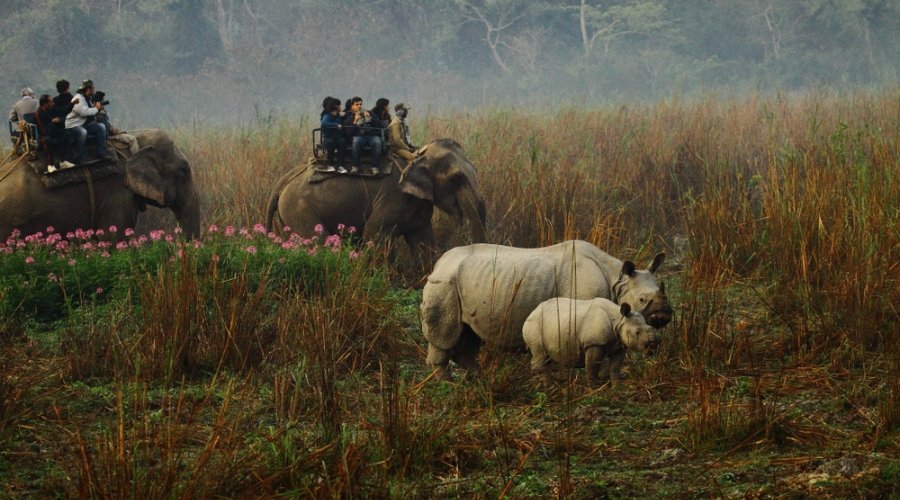
The park shelters over 2,400 one-horned rhinoceros—two-thirds of the global population. Add 1,200 Asian elephants, 100-plus tigers, water buffalo herds, swamp deer, and you’re documenting megafauna concentrations rivaling Africa’s Serengeti. Except here, visibility operates seasonally. February through April, post-grass-burning when fresh shoots attract wildlife to open meadows, delivers peak conditions. Animals emerge from forest cover into photographable terrain while vegetation remains low enough allowing unobstructed sightlines.
What makes Kaziranga landscape photography genuinely exceptional isn’t merely subject abundance but how ecosystems enable considered composition. The jeep safari structure—approximately three hours duration during morning (5:30-8:30 AM) and afternoon (1:30-4:30 PM) slots—allows working light progressively rather than racing against single fleeting moments.
Dawn arrives with mist clinging to grasslands, diffusing sun into soft directional glow perfect for wide-angle work. Elephants crossing beels create leading lines your eye follows naturally through frame. Rhinos positioned against reed backgrounds generate textural contrast—smooth grey skin versus feathered grass. The challenge becomes selecting compositions from abundance rather than desperately pursuing scarce subjects.
The Central Kohora Range particularly delivers this photographic luxury. Sweeping grasslands extend hundreds of metres allowing compositional experiments impossible in forests. Position elephants at golden ratio intersections. Frame rhinos with negative space emphasizing their prehistoric solitude. Capture wetland reflections doubling visual impact. These aren’t opportunistic grabs but deliberate artistic decisions enabled by landscape allowing time and space for thought.
Wide-angle photography in Kaziranga demands different skills than typical telephoto wildlife work. You’re managing foreground interest, middle-ground subjects, and background context simultaneously. A rhino grazing becomes secondary to overall ecosystem story—the grassland sustaining it, the water source drawing it, the seasonal cycles governing its movements. Australian photographers accustomed to India’s tiger parks discover Kaziranga requires landscape photographer thinking applied to wildlife subjects.
The one-horned rhinoceros carries weight beyond mere visual presence. These are survivors from Pleistocene megafauna extinctions, animals that should have vanished millennia ago yet persist through adaptation, isolation, and against considerable odds, dedicated conservation. Their single horn—measuring up to 60 centimetres—distinguishes them from Africa’s two-horned species. Their skin, falling in deep folds at joints, creates armour-plated appearance earning them “armoured unicorn” nickname.
But photographing rhinos in Kaziranga reveals behaviours rarely witnessed elsewhere. They’re remarkably tolerant of vehicles, often grazing within twenty metres of jeeps, allowing extended observation. Mothers with calves—the calf tucked protectively beside maternal bulk—create tender moments contrasting their fierce reputation. Males engaging in territorial disputes demonstrate power that explains how megafauna survived when lighter species perished.
The wide-angle perspective capturing rhinos within landscapes rather than isolated against blurred backgrounds tells conservation stories telephoto work cannot. You witness habitat these animals require—the specific grass heights they prefer, the wallow pools essential for thermoregulation, the spatial relationships with other herbivores sharing resources. This contextual photography becomes environmental documentation wrapped in aesthetic appeal.
To photograph Kaziranga properly requires appreciating Assamese culture surrounding the park. This isn’t merely tiger territory—it’s homeland to communities whose relationship with wilderness predates conservation frameworks by millennia. The park gained protection partly through cultural practices valuing nature reverence over exploitation.
Between safaris, Assamese cuisine offers immersion unavailable through wildlife viewing alone. Masor tenga—tangy fish curry using tomatoes or elephant apple for sourness—represents riverine adaptation where freshwater fish abundance shaped culinary tradition. Khar, an alkaline preparation made by filtering water through dried banana peel ash, functions as traditional meal starter believed cleansing stomach. Duck meat curry, locally called haah, pairs with white gourd in heavily spiced preparations serving festive occasions.
The simplicity defining Assamese cooking—minimal oil, subtle spices, ingredients speaking for themselves—mirrors Kaziranga’s own aesthetic: wilderness requiring no embellishment, landscapes beautiful through inherent structure rather than decorative addition. Premium lodges near the park now employ Assamese cooks maintaining traditional preparations, transforming meals into cultural education complementing wildlife encounters.
Tea, of course, dominates Assamese beverage culture. The state produces some of India’s finest varieties, and lodges serve morning chai before dawn safaris with ceremony matching the ritual. That first sip while mist still clings to grasslands, while elephant families begin morning routines, becomes part of Kaziranga’s rhythm.
For Australian travellers reaching Kaziranga from Australia, logistics flow through Guwahati—Assam’s largest city positioned 250 kilometres west. International flights arrive Delhi or Kolkata. Domestic connections serve Guwahati’s Lokpriya Gopinath Bordoloi International Airport. Road transfers take approximately five hours through Assam’s tea plantation countryside where endless green rows preview the grasslands ahead.
The park operates mid-October through early May, closing during monsoon flooding. November through January delivers comfortable temperatures and lush post-monsoon vegetation. February through April provides highest wildlife visibility as grass burning opens meadows and animals concentrate near remaining water sources, though temperatures climb toward 30 degrees Celsius.
Safari permits require advance booking through Assam’s online portal. The Central Kohora Range—hosting highest rhino concentrations—books earliest. Western Bagori Range offers equally spectacular encounters with lighter tourist pressure. Eastern Agaratoli Range provides river access and excellent birding. Burapahar Range, least visited, rewards adventurous photographers with untouched forest feeling and Hoolock gibbon sightings.
Accommodation near Kaziranga ranges from government lodges to luxury eco-resorts designed around photography requirements. Many properties now cater specifically to solo travellers and women-only groups, recognising that wildlife passion transcends demographics and that India’s tourism infrastructure increasingly supports independent exploration. Properties positioning close to zone gates reduce transfer times, maximising dawn light opportunities crucial for wide-angle landscape work.
Ultimately, Kaziranga’s wide-angle wonders offer photographers something beyond technical achievement. They provide visual testimony to conservation succeeding when commitment meets ecosystem understanding. The one-horned rhinoceros population crashed to double digits early last century. Today’s 2,400 individuals represent recovery achieved through habitat protection, anti-poaching dedication, and crucially, tourism revenue funding rangers who patrol these grasslands daily.
When that elephant matriarch finally leads her family across beel grasslands with the Brahmaputra flowing beyond and Kangchenjunga floating impossibly distant, when your wide-angle composition captures multiple generations moving through landscape their ancestors inhabited for millennia—you’ve documented more than wildlife. You’ve created testimony that wilderness and humanity can coexist when protection becomes priority, when communities benefit from conservation, and when photographers arrive seeking understanding rather than merely collecting images.
The grey giants endure. The armoured unicorns multiply. The Brahmaputra continues its seasonal rhythms. And the wide-angle frames capturing these relationships preserve not just present but possibility—where recovery once deemed impossible becomes documented reality.
The grasslands remember silence. The megafauna reclaim their anthem. The landscape waits, camera-ready.