India Travel Tours From Australia - Adventure | Oceania

India Travel Tours From Australia - Adventure | Oceania
April 9, 2026
Just before sunrise in Rajasthan, something extraordinary happens at the edge of a wetland that most of the world has never heard of.
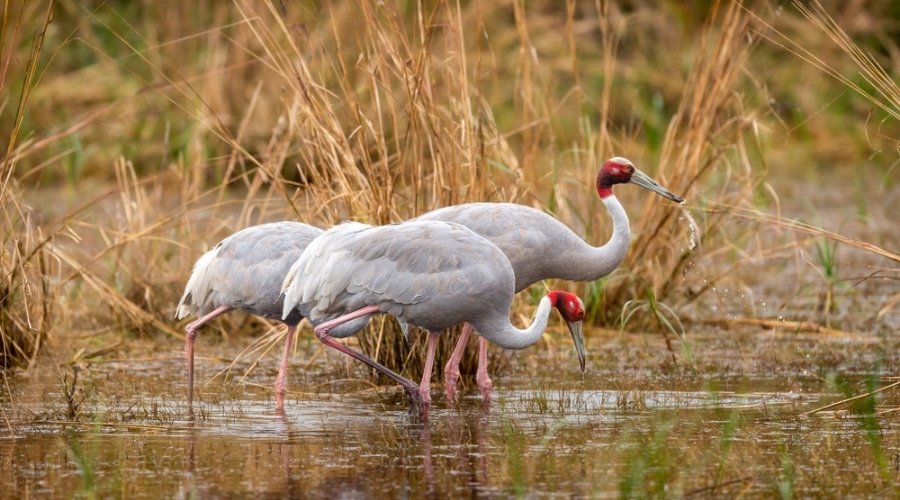
Two grey shapes — taller than most adults standing upright — move toward each other through the low mist. Their scarlet crowns catch the first pale suggestion of light above the treeline. And then they begin. A call so resonant and so ancient it seems less like birdsong and more like a statement — a declaration, thrown across still water, that this place and this partnership belong entirely to them.
The Sarus Crane. The tallest flying bird on Earth. And if you are positioned correctly, with the right guide, in the right light, at the right moment in Keoladeo National Park — your camera raised and your breath held — you will never look at wildlife photography quite the same way again.
Bharatpur’s Keoladeo National Park carries a layered history that makes the place feel more textured than a simple bird sanctuary. Three hundred years ago, Maharaja Suraj Mal created the wetland by constructing an earthen dam across a natural depression where two rivers met. It became a royal hunting ground, then a British colonial shooting retreat. Hundreds of birds were killed in a single day during ceremonial shoots that continued through the early 20th century.
Today, that same wetland is a UNESCO World Heritage Site. No motor vehicles are permitted inside. The only sounds are water, wind, and the calls of over 375 bird species that fill its skies, ponds, and tree corridors from October through February. The transformation of a killing ground into one of Asia’s most celebrated wildlife refuges is one of conservation’s quiet victories — and wandering its paths on a still winter morning, it is impossible not to feel the weight of that change.
Most Australians know the word crane without ever having properly seen one. The Sarus Crane redefines the term entirely.
Standing at nearly two metres tall, it is the largest flying bird anywhere on Earth. Its slate-grey plumage is offset by a bare red head that flushes deeper during breeding season. But what makes the Sarus Crane genuinely remarkable — photographically, emotionally, ecologically — is its behaviour. Sarus Cranes mate for life. They call in unison, a duet performed by a bonded pair in perfect synchrony, each responding to the other across the water in a choreography that has been repeating in these wetlands for thousands of years. When you witness it — and in Bharatpur during winter, you will — it lands somewhere beyond photography. It lands in the chest.
The challenge and the reward of photographing Sarus Cranes is their habitat. They favour open wetland margins and adjacent agricultural fields, moving between the two with a calm authority. The light that falls across these open areas at dawn — golden, horizontal, soft — turns every frame into something painterly. A pair calling with wings half-raised, their reflections doubling in still water, is the kind of image wildlife photographers specifically journey to Bharatpur to make.
If the Sarus Crane is the soul of Bharatpur, the Painted Stork is its spectacle.
Its name is not hyperbole. The Painted Stork wears a white and black body interrupted by a wash of deep salmon-pink across its wings — a colour so vivid and so precisely placed it genuinely looks applied rather than grown. A curved, bright yellow bill completes a bird that looks, in full morning light, like something designed by an artist who didn’t believe in restraint.
Painted Storks breed in Bharatpur in large, noisy colonies in the park’s interior woodland — dozens of nests crowded into the same trees, the air thick with the clatter of bills and the movement of wings. For photographers, a nesting colony in the warm amber light of a Bharatpur morning is one of India’s great visual experiences — colour, movement, layering, and behaviour all compressed into a single frame. The challenge is not finding them. The challenge is choosing which frame among hundreds to actually keep.
The Silence That Makes Everything Possible
Here is the detail that separates Bharatpur from almost every other wildlife photography destination in India — and it is the detail that most travel guides bury in their logistics sections without understanding what it actually means.
No motor vehicles are allowed inside Keoladeo National Park. Not jeeps, not tuk-tuks, nothing combustion-powered. Visitors explore on foot, bicycle, or electric rickshaw along flat, shaded paths that wind through the wetland. The absence of engine noise creates an intimacy between photographer and subject that is simply unavailable in most wildlife parks. Birds are not alarmed by your approach the way they would be from a jeep. They go about their business at close range — feeding, preening, displaying — completely at ease.
For Rakesh Arora, who approaches every wildlife encounter as an act of patience and reverence, Bharatpur’s silence is a gift. Moving slowly, reading bird behaviour before raising the camera, understanding where the light will fall across a nesting stork colony thirty minutes from now — these are the decisions that produce the images. And in a park where the birds themselves are unafraid, those decisions make all the difference.
October through February is Bharatpur’s prime season, when migratory species from Central Asia, Siberia, and China arrive to join the resident population. November and December bring the largest congregations — bar-headed geese, ruddy shelducks, northern shovelers, Eurasian spoonbills, and purple herons join the Sarus Cranes and Painted Storks in a density of birdlife that no other park in India can match.
For Australians, the timing is almost perfectly aligned with the Australian summer holiday window — a trip that combines Bharatpur’s extraordinary birdlife with the nearby Taj Mahal, Rajasthan’s forts and palaces, and the warmth of a north Indian winter that feels designed for long, unhurried mornings in the field.
Some wildlife travellers prefer expert-led photography journeys where every dawn positioning and every light window is considered in advance — where the guide already knows which colony is active and where the cranes will be calling at first light. In a park as rewarding as Keoladeo, that foreknowledge is the difference between good images and extraordinary ones.
Long after you leave Bharatpur, something stays with you that photographs alone cannot carry.
It is the sound of two Sarus Cranes calling across still water before the sun has cleared the horizon. A sound that has been rising from these wetlands every winter morning for centuries, through everything the world has thrown at this place — through hunting parties and droughts and conservation battles and political debates — unchanged, unhurried, entirely itself.
Some sounds remind you of what the world was before it got so complicated. Bharatpur has one of them. And the right morning, in the right light, will make sure you hear it.