April 8, 2026
Most people who dream of India’s wildlife think of tigers. And fair enough — a Bengal tiger stepping from the shadow of a sal tree is one of the great encounters this planet offers.
But there is another India. A wider, flatter, more ancient India — where the Brahmaputra River floods a landscape so vast and fertile it gave rise to creatures that look like they belong in another geological era entirely. Where a two-tonne rhinoceros grazes at the waterhole’s edge like it has been doing so for ten thousand years. And where a wild water buffalo — genuinely wild, not the domesticated version you might picture — watches your jeep with a calm, prehistoric authority that stops your breath faster than any predator ever could.
This is Kaziranga. And if you haven’t put it on your wildlife list yet, that’s about to change.
Understanding Kaziranga begins with understanding the Brahmaputra — one of the great rivers of the world, and the force that shaped every square metre of this UNESCO World Heritage Site. Each monsoon season, the river floods the entire park. It sounds dramatic. It is dramatic. But this annual flooding is not a disaster — it is the park’s engine. The retreating waters deposit fresh alluvial soil across the floodplains, renewing the tall elephant grass, replenishing the wetlands, and creating a mosaic of grassland, forest, and swamp that supports one of the densest concentrations of large mammals anywhere on Earth.
Kaziranga holds more than two-thirds of the world’s remaining greater one-horned rhinoceroses. It also holds the world’s largest population of wild water buffalo — a fact that almost nobody talks about, and yet one that makes this park doubly extraordinary for anyone who cares about rare wildlife encounters. Together with Bengal tigers, Asian elephants, and eastern swamp deer, these two species form what naturalists call Kaziranga’s Big Five — a collective that rivals anything Africa offers, in a landscape that feels entirely, unmistakably Indian.
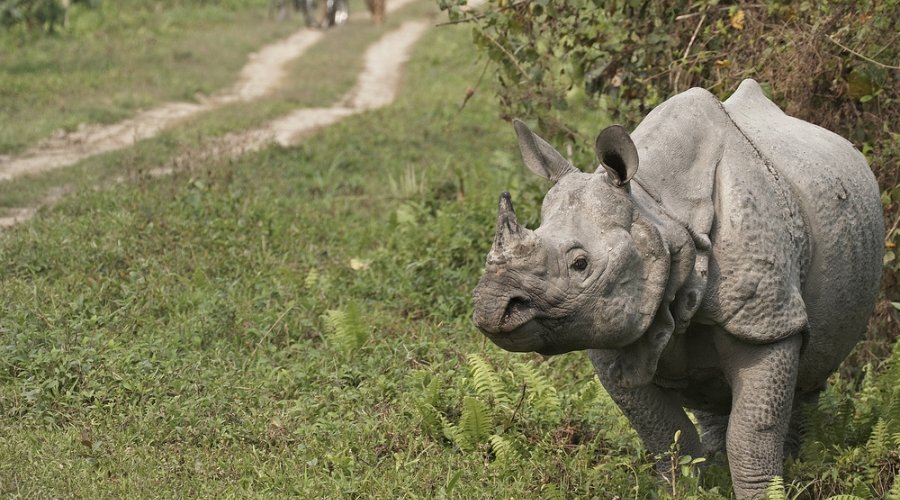
Nothing prepares you for the scale of a greater one-horned rhinoceros at close range.
Its skin is not smooth hide — it is folded, riveted, and raised into deep knobs and plates across its shoulders and flanks. It genuinely looks armoured. In the morning light of a Kaziranga grassland, when the mist is still low and the Brahmaputra glitters somewhere beyond the treeline, a rhino grazing in the open grass catches light in a way that makes the image look sculpted rather than photographed. Ancient and monumental. A living piece of natural history that somehow survived everything the modern world threw at it.
A century ago, fewer than 200 remained. Poaching had compressed a species that once roamed across the entire northern subcontinent into a ghost population on the edge of extinction. The conservation effort that followed — patient, committed, generational — brought that number back to over 2,600 today. Photographing a one-horned rhinoceros in Kaziranga is not just a wildlife encounter. It is witnessing a species that chose to come back.
What makes rhino photography in Kaziranga so special is the openness of the terrain. Unlike predator sightings in dense jungle, rhinos move through open floodplain grasslands in plain sight — grazing, wallowing in swamps to protect their skin from the sun, drinking at waterholes with complete ease. A patient, well-positioned photographer can spend forty uninterrupted minutes with a single animal in natural behaviour. The light moves across its flanks. A cattle egret rides its back. A calf drifts close to its mother. These are the kinds of sustained, intimate encounters that most wildlife destinations simply cannot offer.
If the one-horned rhino is Kaziranga’s famous face, the wild water buffalo is its best kept secret.
Most Australians imagine a domestic water buffalo when they hear the name — the kind that pulls a cart or stands in a rice paddy. The wild water buffalo of Kaziranga is something else entirely. Heavier, darker, with sweeping horns that span wider than almost any other bovine on Earth, they move through the park’s grasslands and wetlands in herds that carry a weight of wildness entirely their own. These animals have never been domesticated. They have never been managed. They have lived in this landscape through floods and seasons and centuries, and when a herd turns to look at your jeep — a hundred dark eyes under curved horns — the encounter is genuinely arresting.
Kaziranga holds around 57 percent of the world’s entire wild water buffalo population. And yet they appear in almost nobody’s wildlife photography itinerary. They are the giant the world forgot to look at.
Kaziranga’s four safari ranges — Central, Western, Eastern, and Burapahar — each offer different character and different photographic potential. Central range holds the park’s highest rhino density and is where the open grassland encounters happen most reliably. Western range is wilder, denser, and rewards those willing to move away from the crowd. Buffalo are most commonly encountered near wetland edges and seasonal floodplain corridors — knowing where those corridors are on any given morning requires the kind of ground intelligence that only comes from experience.
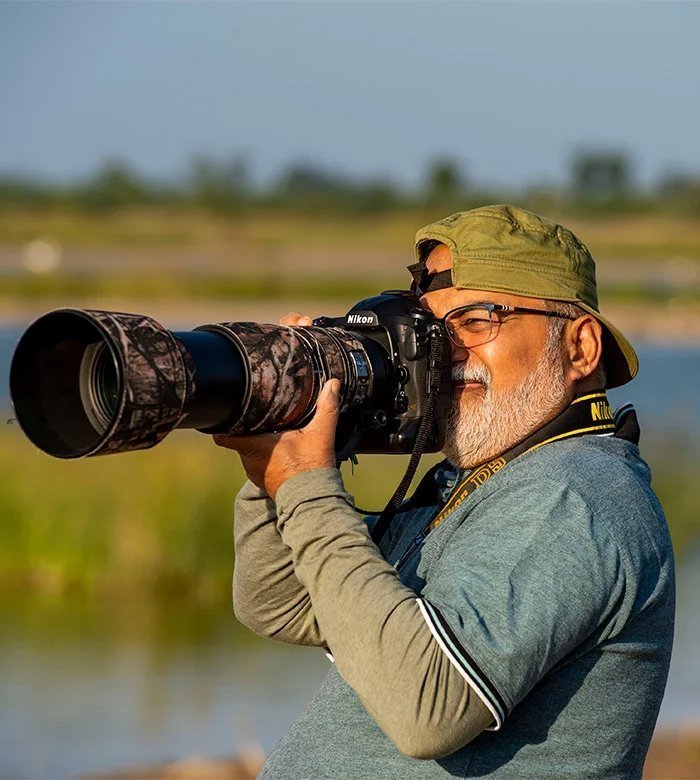
For Rakesh Arora, every drive is a conversation with the landscape rather than a predetermined route. Knowing how the morning light will fall across the Central range grasslands. Understanding which wetland edge the buffalo have been using at dusk. Recognising the moment when a rhino is about to turn toward the light rather than away from it. These decisions live in years of presence — and they are what transform a wildlife visit into a photography expedition that produces images worth keeping.
Some travellers arrive at Kaziranga and see rhinos. Others arrive with someone who already knows where the light will be perfect, which range is performing, and when to stay very still — and they come home with something far more rare than a sighting.
The park opens in October and closes in late May, shutting for the monsoon floods that renew its landscape each year. November through February is beautiful — cool mornings, extraordinary birdlife, rhinos in peak condition after the flush of post-flood vegetation. The mist that settles over the grasslands during these months gives Kaziranga a quality that landscape photographers specifically travel for.
March and April thin the vegetation and concentrate wildlife around water. Sightings become more frequent, more behavioural, and more sustained. Buffalo herds are visible at longer distances across open floodplain. Rhinos with young calves move into open ground. The light turns warm and golden in ways that make every morning safari feel designed for photography.
For Australians, the timing aligns beautifully — India’s prime season sits almost perfectly across Australian autumn and early winter, precisely when the wild starts calling from somewhere far beyond the Pacific.
Kaziranga is one of the great conservation success stories of the 20th century. The numbers alone are extraordinary. But what stays with you long after the images are edited and the trip is filed away is something harder to quantify — the feeling of standing in a landscape where a species came back. Where the wild held its ground. Where two of the planet’s rarest large animals go about their ancient lives in a floodplain that a river builds and renews every single year.
Some journeys change what you think is possible. Kaziranga is one of them. And the right guide makes sure you are exactly where the light and the giants meet.